
.png)

Additional remuneration: secure and enhance your renewable energy production
The economic model of renewable energy (EnR) producers has changed profoundly in recent years. Gone are the days of a fully guaranteed purchase price: installations are now more exposed to the mechanisms of the electricity market.
It is in this context that the compensation supplement (CR), a system that reconciles market integration and income security. Often misunderstood, this mechanism nevertheless plays a central role in the valorization of renewable electricity.
In this article, we explain to you clearly how the remuneration supplement works, the challenges for renewable energy producers and the impact on commercial strategy and revenue optimization.
Definition of additional remuneration
The Remuneration supplement Is a public support mechanism intended for renewable electricity producers.
Unlike the old compulsory purchase system, where electricity was sold at a guaranteed fixed rate, the producer now sells its energy directly on the market.
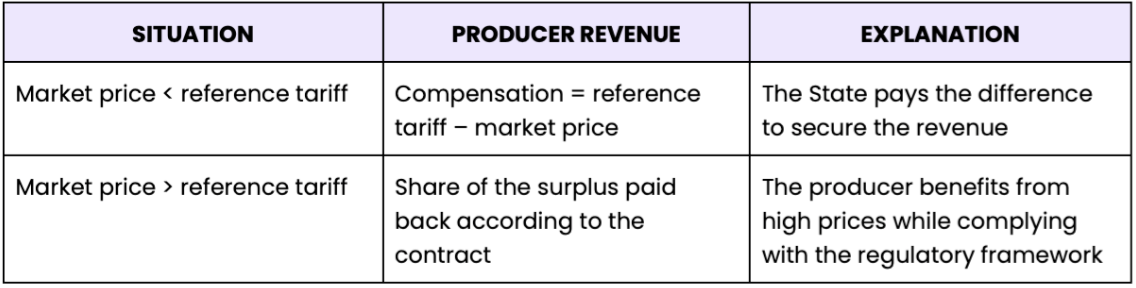
- If the market price is lower than the reference rate set by the State, a financial compensation is paid to make up for the difference.
- If the market price is higher, the producer may have to pay back part of the surplus.
Concretely, CR stabilizes revenues while maintaining market exposure, offering both security and incentives to optimize marketing.
Why was this mechanism put in place?
The remuneration supplement has two objectives:
- Expose producers to market signals to promote better integration of renewable energies
- Maintaining a secure income level despite price volatility
It is part of the logic of European energy transition, aimed at gradually integrating renewable energies into the normal functioning of the market. This mechanism is governed by the Energy Regulatory Commission (CRE).
Who is affected by this mechanism?
The additional remuneration applies mainly to installations resulting from tenders, in particular:
- Wind power plants
- Solar installations
- Some hydroelectric installations
How does the compensation supplement work?
The principle is based on a comparison between: The market price and the reference rate:
What is the impact for a producer?
Additional remuneration is profoundly transforming the logic of valuing electricity. The producer no longer sells at a guaranteed fixed rate.
He must now:
- Access the market
- Selling your electricity at the best time
- Managing the differences between forecast and actual production
- Optimizing your commercial strategy
In other words, the producer becomes an active player in the market, this is where the role of aggregator comes into its own in order to secure and optimize valuation.
Concrete example: valuation under additional remuneration
Let's take a solar power plant with additional remuneration. Its reference rate is fixed at €90/MWh.
If the market price falls to €70/MWh:
- The power plant sells on the market at €70
- She receives a supplement of €20
- His total income reached €90
If the market rises to €110/MWh:
- The power plant sells for €110
- It can repay part of the surplus according to contractual rules.
This mechanism thus ensures financial stability while maintaining market dynamics.
How to optimize your renewable energy strategy with additional remuneration?
At Bohr Energie, we support producers in the following logic:
- Analysis of your production portfolio
- Identification of optimization levers (spot market sales, PPPs, adjustment mechanisms)
- Management of valorization to secure revenue and reduce risks
- Training and personalized follow-up to make full use of the additional remuneration
Let's talk about your installation